

You Call It Fate? It Might Be a Pattern You Keep Repeating
Sad tears invite repeated misfortune. It sounds harsh, almost as if crying somehow attracts bad luck. But that’s not what this really means.
Relax! I’m not saying that crying will bring you bad luck. What I’m highlighting is the “way” you cry. If you cry while dwelling on misfortune, it can keep your life stuck, like circling the same hole over and over again.
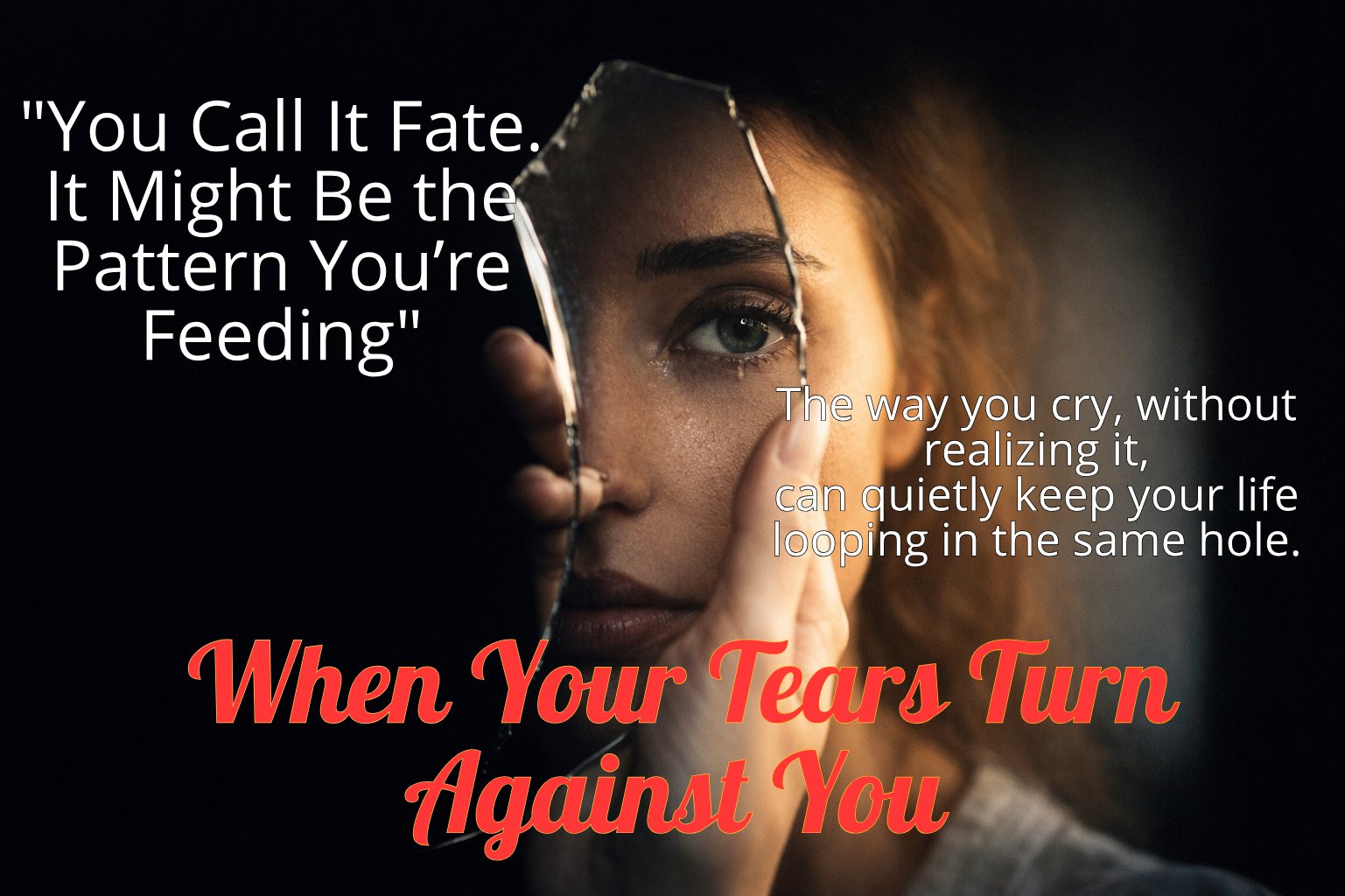
A lot of people say, “My life is just unlucky.” Yet every night before bed, the only thing they replay are the worst moments. They obsess over rejection, failures, and somehow turn themselves into the main character of a victim story.
Then they break down in the bathroom, drowning in their own sorrow, wondering why life never seems to change. Sad tears themselves are neutral. Biologically, crying is an emotional regulation mechanism. The body releases pressure. It’s healthy. It’s human. But the moment those tears get attached to a victim narrative, that’s where the real problem begins.
Are You Crying… or Training Yourself to Be the Victim?
Factually and backed by scientific research, the brain isn’t a passive observer. It’s a pattern-building machine constantly working behind the scenes. In neuroscience, there’s a well-known principle: neurons that fire together wire together, meaning the neural pathways you activate most often grow stronger over time. Simply put, what you repeatedly think and feel eventually becomes your default setting.
So when you feel sad and keep repeating things like, “I’m just never lucky,” or “Other people have it easy, not me,” or even conclude, “This is just my fate,” you’re actually doing more than just venting. Without realizing it, you’re training your own neural pathways. And emotion is like turbo fuel. The stronger the emotion, the faster those pathways solidify, and the easier they get triggered again the next time.
At the same time, your amygdala kicks in every time you sink into sadness. “Wait, what even is the amygdala?” It’s not a skincare brand. It’s a small structure in your brain that acts like an emotional alarm system. Picture an over-alert security guard. The slightest hint of drama, and the siren goes off.
The amygdala is basically your brain’s security team, scanning for threats — even the ones that aren’t really threats. It processes fear and intense emotions, and without hesitation, it flips the switch to fight, flight, or freeze.
And the most dangerous part is that the amygdala makes emotional memories extremely sticky. That’s why an embarrassing moment from five years ago can still feel vivid, while you can barely remember what you had for breakfast last week. If you often cry while repeating a victim narrative, the amygdala doesn’t know it’s just a thought. To it, that’s a real threat. So it marks it, stores it, and prepares the same response again for tomorrow. Your brain isn’t evil. It simply follows whatever you keep putting in the spotlight.
Your Brain Is a Proof-Seeking Machine
The hippocampus stores the memory, while the prefrontal cortex builds the story around it. So when sorrow is replayed again and again, your brain slowly learns one thing: find proof that life is unlucky. The more that narrative loops, the more automatic your system becomes in that direction. Without realizing it, your brain isn’t just storing experiences — it’s organizing them into patterns that start to feel consistent and real.
Then the next day, something neutral happens — nothing dramatic, nothing special. But because of negativity bias and confirmation bias, your brain instantly reacts, “See? Proof again.” Except it’s not proof. It’s a filter. So you’re not actually experiencing repeated bad luck — you’re viewing the world through lenses you’ve been polishing every single night.

Sorrow Can Become a Subtle Addiction.
In psychology, there’s a term called rumination. It’s not just feeling sad — it’s the habit of replaying negative experiences like a sad playlist stuck on repeat with no skip button. When someone keeps feeding that sorrow, stress lingers. Cortisol stays elevated, and the nervous system remains on high alert as if the threat never ended. Over time, what started as a temporary emotion slowly hardens into a lasting pattern.
Over time, your identity can start to shift as well. What used to be “I’m going through a failure” slowly turns into “I am a failure.” That’s a huge difference. Tears of sadness mixed with excessive identification are like wet cement. If you keep pouring negative stories over it, sooner or later it hardens, and once it’s hard, every small event sticks to it instantly. Then you call it fate, even though if you’re honest, it’s just a pattern you trained yourself. What you used to focus on repeatedly eventually becomes a mental highway with no traffic.
Rewiring the Pattern: How Change Actually Happens
This part might feel heavy, so don’t get defensive right away. Just keep an open mind for a moment.
First, there’s something called synaptic plasticity. In simple terms, the connections between neurons can strengthen or weaken depending on how often they’re used. There’s a process known as Long-Term Potentiation (LTP), where synapses become more responsive the more frequently they’re activated. This is the foundation of memory and learning. Eric Kandel even won a Nobel Prize for proving that these tiny molecular changes are real — not just theory.
What does that mean? Every pattern you keep repeating literally strengthens on a biological level.
Second, there is structural plasticity. This operates at a deeper level. Your brain can literally grow new branches or prune connections that are rarely used. Dendrites can expand and branch out more when certain pathways are activated frequently. On the other hand, pathways that are rarely used can weaken and gradually disappear.
Think of it like a dirt road in a small town. If people walk on it every day, it eventually becomes wider and more defined. But if no one uses it, it gets overgrown with weeds. Your brain works the exact same way.

But Listen Carefully: Tears Are Not the Enemy
I’m not against crying, so don’t get it twisted. Sad tears can actually become a tool for mental clarity. When you cry and tell yourself, “This is disappointment, but it’s not who I am,” you create a healthy distance between emotion and identity. In that moment, you’re separating logic from feeling instead of getting trapped inside the story.
Mindfulness research shows that when someone observes their emotions without clinging to them, the connection between the prefrontal cortex and the amygdala strengthens. That means you can still feel sadness — but you don’t drown in it.
Crying over “bad luck” while feeding a victim story only strengthens the old pattern. But crying with awareness creates a new one — healthier, wiser, more grounded. The difference is subtle, but the impact is massive.
A Sensitive Heart Is Not the Cause of Bad Luck
Some people cry easily not because their life is falling apart, but because they’re moved by goodness. They see genuine kindness and their eyes fill up. They hear a story of resilience and feel warmth in their chest. That’s not weakness.
Research on moral elevation shows that feeling deeply moved by goodness actually increases empathy and the desire to become better. In other words, tears that rise from genuine conscience strengthen your humanity.
What’s dangerous isn’t having a gentle heart, but when lamentation of sorrow becomes your identity. You can stay soft, but don’t turn that softness into a reason to keep repeating stories that make you feel small.

Bad Luck Doesn’t Fall from the Sky. It’s Trained.
We often blame circumstances, but if we’re honest, our response patterns are incredibly consistent. Every time you’re disappointed, you dwell on it completely. When you fail to reach a goal, you instantly generalize as if one setback defines your entire life. When love rejects you, you rush to conclude, “I’m not enough.” Over time, that’s no longer a spontaneous reaction — it becomes an automatic habit.
And that’s where the problem starts. It’s not coincidence — it’s brain training. Neuroplasticity shows that your brain changes based on what you practice most. If you train your chest consistently, your chest grows. On the other hand, if you train sorrow every single day, don’t be surprised when the “bad luck” pattern gets stronger and shows up faster.
Simple. Brutal. Factual.
Sad tears can invite repeated bad luck if you use them to reinforce a victim story. But those same tears can also become the starting point of a new version of you — if you use them to let go.
Read Also: No Wonder Your Affirmations Keep Failing, Still Chasing Wealth? That’s the Poverty Talking
So the Choice Isn’t to Stop Crying
The choice isn’t about stopping yourself from crying or pretending to be strong. The real question is simple: are you crying while building a prison, or crying while opening a door? You’re allowed to cry. Seriously. Just don’t turn it into training for becoming a professional victim. Sad tears can clear your perspective and reset how you see your life — but only if you use them to release the old story, not reinforce the one that keeps you small. Don’t let sorrow harden into your identity.
Because in the end, your life isn’t defined by one bad day — it’s defined by the pattern you repeat after it. And if this makes you uncomfortable, maybe it’s not because it’s wrong. Maybe it hits. If you want to go deeper into this, you can reach out to me.














 Bahasa Indonesia
  English
  Français